Content Repurposing: Turn 1 Video Into 30 Posts
A repeatable framework for turning a single recording into a month of short-form video — without burning out or diluting quality.
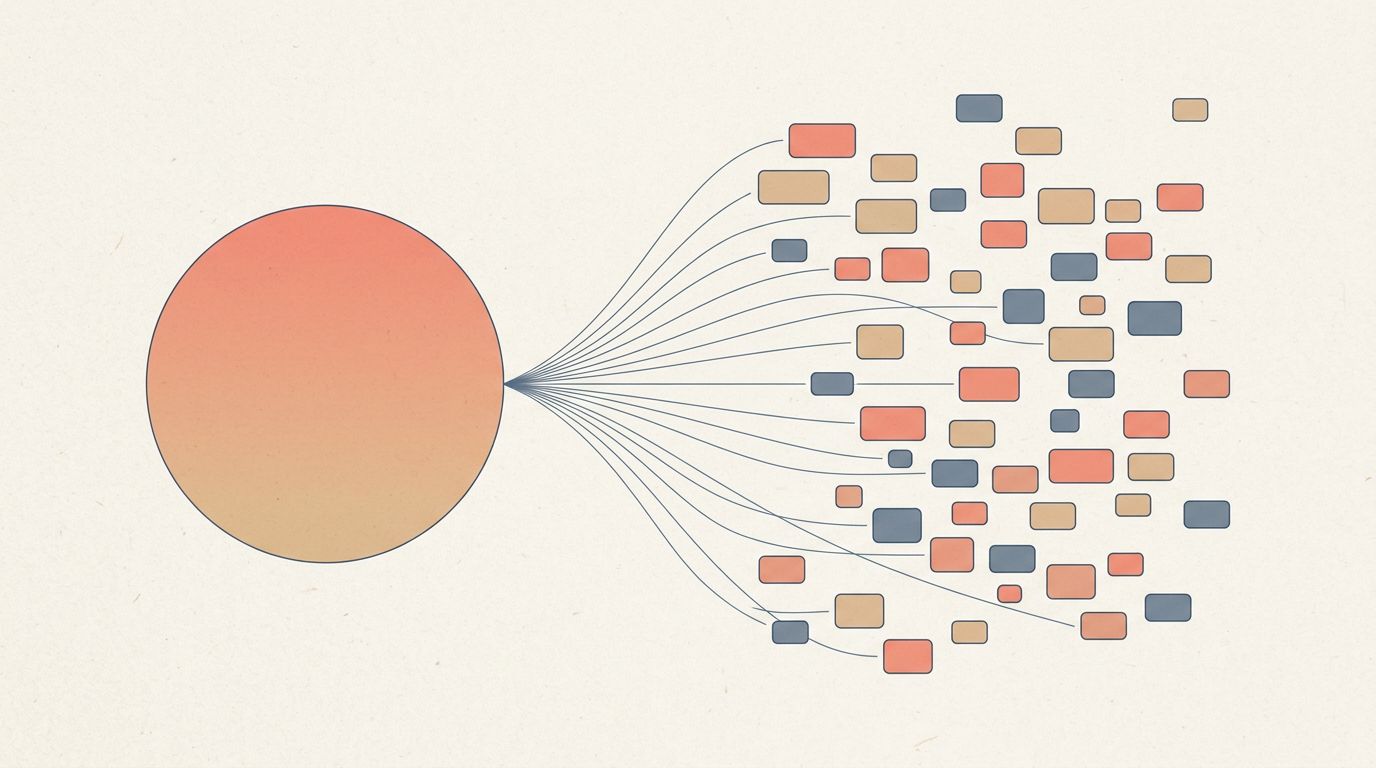
Repurposing is not recycling. It is extraction: mining one dense recording for every standalone idea it already contains.
Content repurposing is the practice of turning one piece of content into many — most powerfully, turning a single long video or recording into dozens of short-form clips, posts, and assets tuned for each platform. Done well, it is the highest-leverage move in social video: brands that repurpose strategically publish 5 to 7 videos a week while producing only 2 to 3 original pieces. This guide gives you a concrete framework — the 1-to-30 Engine — plus a checklist and a posting mix you can copy today.
The math is simple and the stakes are real. Short-form video generates roughly 2.5x more engagement than long-form, and algorithms reward recency: accounts that go quiet for two to four weeks see reduced reach even on content that used to perform. Consistency is the tax you pay for reach. Repurposing is how you pay it without a full-time studio.
What is content repurposing (and what it is not)
Content repurposing means reformatting and redistributing one source asset into multiple derivative pieces across formats and channels. A 20-minute podcast becomes eight vertical clips, four quote graphics, one carousel, one newsletter, and a blog post.
It is not recycling — reposting the same file everywhere and hoping. And it is not spinning thin variations of a weak idea. Repurposing only works when the source is dense enough to survive being broken apart. The test: can you pull five to ten standalone moments — a tip, a story, a mistake, an example, a hot take — from the source? If yes, it is a repurposing goldmine. If no, fix the source before you fan it out.
Repurposing is not recycling. It is extraction: mining one dense recording for every standalone idea it already contains.
Why content repurposing matters in 2026
The platforms now demand a cadence no single-shoot workflow can sustain. TikTok rewards daily posting; Instagram Reels and YouTube Shorts want at least weekly, ideally several times a week. Brands average about five posts per week on Instagram and TikTok — a bar most teams miss not for lack of ideas but for lack of throughput.
Three forces make repurposing the answer:
- Algorithmic recency. Reach decays with silence. A steady stream of derivative clips keeps your account "warm" between big productions.
- Cost per asset. Original production is expensive; a derivative clip is nearly free once the source exists. Teams using AI workflows now produce 13+ assets from a single webinar in about two hours.
- Platform-native fit. The same idea lands differently on TikTok, Reels, and Shorts. Repurposing lets you tailor the hook, caption, and pacing per platform instead of cross-posting one flat file.
The 1-to-30 Engine: a step-by-step framework
Here is the framework. Start with one strong source and work through five stages. The goal is not 30 posts for the sake of a number — it is 30 distinct, platform-ready assets from a single afternoon of source material.
Step 1 — Choose a "pillar" source worth mining
Pick or record one dense, 15-to-30-minute piece: a founder Q&A, a customer interview, a product walkthrough, a webinar, or a talking-head deep dive. Density beats polish. Before you record, list the five to ten questions or moments you know will each stand alone. If you can't, the source isn't ready.
Step 2 — Extract the standalone moments
Watch the source once and timestamp every self-contained idea: a tip, a surprising stat, a customer story, a myth you bust, a before-and-after. Aim for 8 to 15 moments. Each becomes the seed of a short. This is the single most important step — a clip fails when it depends on context the viewer never saw.
Step 3 — Rebuild each clip hook-first
A raw excerpt is not a short. Re-cut each moment so the payoff or tension lands in the first three seconds — the window that decides whether a video is watched or scrolled past. Add a text hook, trim the throat-clearing, and end on a clean beat. If you want the mechanics of this, see why the first three seconds make or break a video.
Step 4 — Adapt per platform, not per upload
Take each rebuilt clip and tune it for its destination: a punchier text hook for TikTok, a cleaner aesthetic and trending audio for Reels, a searchable, keyword-led title for Shorts. Same idea, three natively-optimized versions. This is where cross-posting quietly kills reach and true repurposing wins.
Step 5 — Fan out beyond video
Your pillar source is also text. Pull one blog post from the transcript, three to five quote graphics, a carousel of the key takeaways, and a newsletter section. Even static images can become video: you can turn photos and graphics into motion clips with AI to keep everything in the short-form feed.
The repurposing math: what one source yields
A realistic yield from a single 20-minute pillar recording:
| Asset type | Quantity | Destination |
|---|---|---|
| Short-form video clips | 8–15 | TikTok, Reels, Shorts |
| Quote / stat graphics | 3–5 | Instagram, LinkedIn |
| Carousel post | 1 | Instagram, LinkedIn |
| Blog post (from transcript) | 1 | Website / SEO |
| Newsletter section | 1 | |
| Photo-to-video motion clips | 3–5 | Feeds and Stories |
That is 17 to 28 assets — comfortably a month of daily posting — from one afternoon of work.
A weekly posting mix you can copy
Volume without a plan turns into noise. Use a simple ratio: for every 1 original pillar, publish 8 to 10 derivatives across the week. A workable weekly cadence for a lean team:
- Mon–Fri: one repurposed short per platform per day (hook-first, platform-tuned).
- Twice a week: one static asset (quote graphic or carousel).
- Once a week: the newsletter or blog derivative.
- Every 1–2 weeks: record one new pillar source to refill the pipeline.
This keeps you at the five-plus-posts-per-week benchmark without demanding five original shoots. For the wider planning picture, pair this with a social media video strategy built for 2026.
Where AI fits — and where it doesn't
AI is what makes 1-to-30 realistic for a small team. It can transcribe the source, surface the strongest moments, cut hook-first clips, and even generate net-new short-form videos from a concept or a product image when your pillar library runs dry. Tools like rgba turn an idea or reference image into a publish-ready vertical video in about three minutes, which lets you top up the feed on days you have no source to mine.
What AI should not do is invent the point of view. The pillar source — the opinion, the customer truth, the original framing — still comes from you. AI multiplies a strong signal; it cannot manufacture one.
Tips and reminders
- Density in, volume out. A weak source yields weak clips no matter how many you cut.
- Never cross-post raw. Re-tune the hook and caption per platform every time.
- Batch the boring parts. Transcribe, timestamp, and cut in one sitting; publish across the week.
- Track winners, then re-mine them. A clip that pops is a signal to produce a new pillar on that exact topic.
- Refill before you run dry. Schedule the next pillar recording before the last one is fully spent.
Frequently asked questions
How many posts can you get from one video?
A dense 20-minute source typically yields 17 to 28 assets: 8 to 15 short-form clips plus quote graphics, a carousel, a blog post, and a newsletter section. Creators using AI workflows report 13+ assets from a single webinar in about two hours. The number depends less on length than on how many standalone moments the source contains.
Is content repurposing bad for SEO or the algorithm?
No — as long as you adapt, not duplicate. Reformatting one idea into platform-native clips, graphics, and a blog post is repurposing and is rewarded. Posting the identical file across every channel is cross-posting, which algorithms discount. The line is whether each version is genuinely tuned to its destination and format.
How often should brands post short-form video?
TikTok rewards daily posting; Instagram Reels and YouTube Shorts reward at least weekly, ideally several times a week. Brands average around five posts per week on Instagram and TikTok. Accounts that go quiet for two to four weeks see reduced reach when they return, so consistency matters more than any single viral hit.
What makes a good source video to repurpose?
Density and standalone moments. The best sources — founder Q&As, customer interviews, webinars, product walkthroughs — contain five to ten self-contained ideas that each make sense without context. If you cannot list those moments before you cut, the source is too thin to repurpose well.
Can AI repurpose video content automatically?
Largely, yes. AI can transcribe a source, identify the strongest moments, cut hook-first vertical clips, and generate new short-form videos from a concept or image. It handles the throughput. What it cannot do is supply the original point of view — the opinion and customer insight that make a clip worth watching still come from you.