How to Build a Social Media Video Strategy That Works in 2026
Most brands know they need more video. Few have a system for producing it consistently. Here's how to build one.
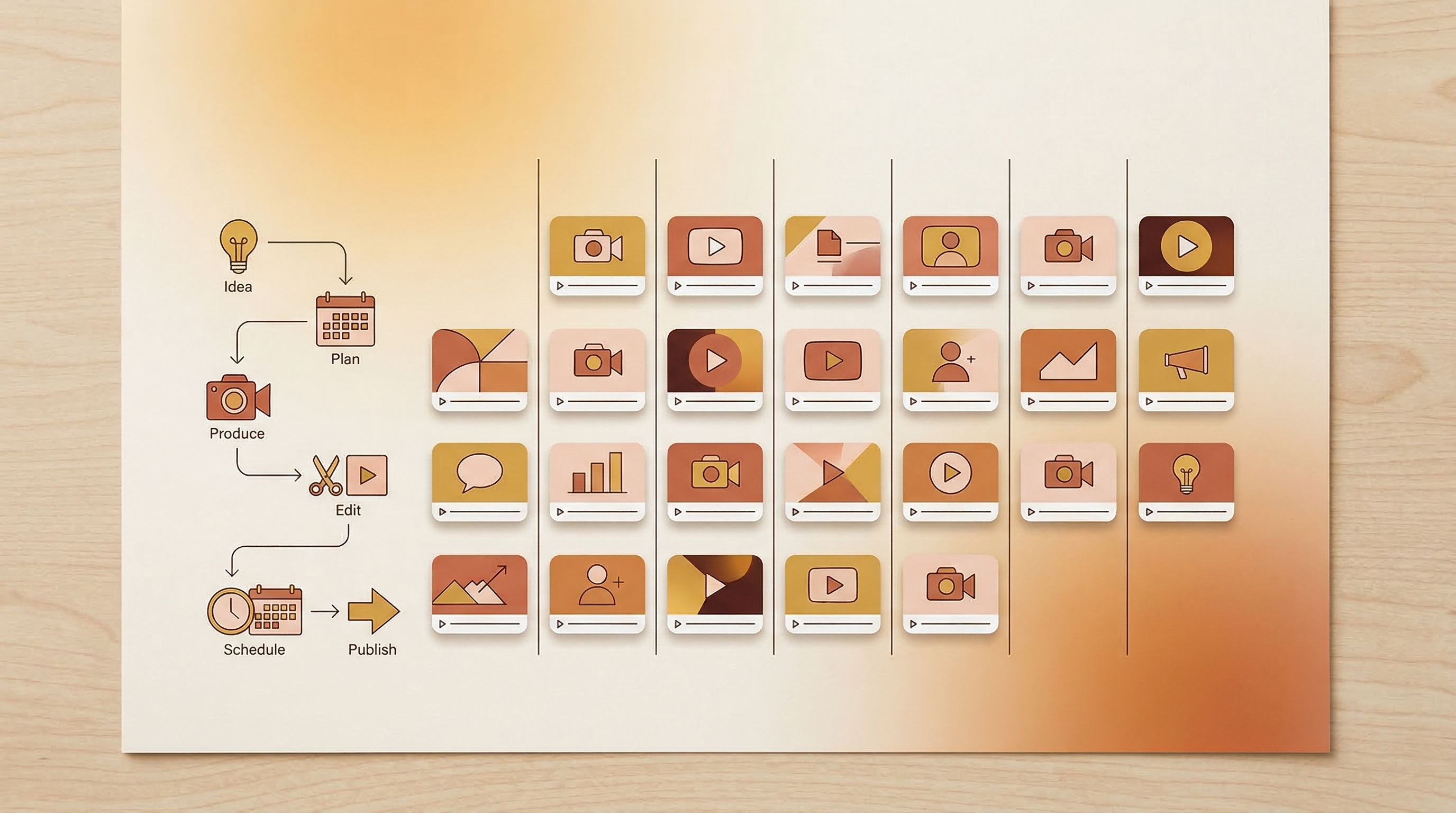
The brands winning at social video in 2026 are not necessarily the ones with the biggest budgets. They're the ones with the clearest strategy, the most efficient production workflow, and the discipline to post consistently and measure honestly.
Most brands know they need more video. Few have a system for producing it consistently. Here's how to build one.
The evidence is no longer ambiguous. In 2026, 91% of businesses use video as a marketing tool — the highest level ever recorded — and 93% of video marketers describe it as central to their overall strategy. Yet the two biggest reasons companies still aren't doing it are cost (24%) and time (24%). And nearly one-fifth say they simply don't know where to start.
This is a solvable problem. Not because video has suddenly become cheap or easy in the traditional sense, but because the production bottleneck has fundamentally changed. The question is no longer whether you can afford to produce video — it's whether you have a strategy worth executing.
This guide gives you that strategy.
What Is a Social Media Video Strategy?
A social media video strategy is a documented plan that defines what video content you'll create, who it's for, where you'll publish it, how you'll produce it, and how you'll measure success. It is not a content calendar. It is not a list of video ideas. It is a system that produces consistent, on-brand video output aligned to measurable business goals.
The distinction matters because most brands treat video as a series of one-off projects: they hire a videographer for a product launch, post it, and then go quiet for three months. That's a campaign, not a strategy. The brands that win at video — on TikTok, Instagram Reels, YouTube Shorts, and LinkedIn — think of themselves as media companies. They build repeatable workflows, not occasional productions.
Why Most Video Strategies Fail
Before building the right system, it helps to understand what breaks the wrong ones.
Production dependency. When video creation requires an agency or a dedicated videographer, output is gated by budget cycles and scheduling. The moment cash flow tightens or the videographer leaves, the content calendar collapses.
Optimizing for production quality over frequency. A polished 90-second brand video posted once a quarter will be beaten — in reach and engagement — by a consistent stream of well-structured 15-second videos posted weekly. Algorithms reward cadence. Audiences reward familiarity.
No clear goal. "We need to be on TikTok" is not a strategy. Awareness, consideration, and conversion each require different video formats, tones, and calls-to-action. Without defining the goal, you can't define success.
Measuring vanity metrics. Views and likes feel validating. But if your video content isn't driving profile visits, link clicks, email signups, or purchases — it's brand wallpaper, not marketing.
Step 1: Define Your Video Goal and Audience
Start with one question: what should someone do, feel, or believe after watching your video?
The answer determines everything else. At the awareness stage, you're interrupting a scroll and planting a brand impression — which calls for quick hooks, emotional resonance, and no hard sell. At the consideration stage, you're answering a question or demonstrating a solution — which calls for clarity, specificity, and proof. At the conversion stage, you're removing the last objection before a purchase decision — which calls for testimonials, demos, and directness.
Most brands try to accomplish all three goals with a single type of video. Don't. Pick the stage you're most behind on, build a video approach for that stage specifically, and measure results accordingly.
Your audience definition should be equally specific. "Small business owners" is not an audience. "E-commerce founders who are running paid social ads but struggling to produce enough creative content to test" is an audience — and it immediately tells you what to say, how to frame it, and which platforms to use.
Step 2: Choose Your Platforms and Formats
Platform choice follows audience, not trend. Where your specific buyers spend time should determine where you post — not where you personally spend time, and not where a competitor happens to be active.
That said, in 2026, three short-form video platforms dominate organic reach for most consumer and SMB audiences:
- TikTok — Highest organic reach potential. Rewards novelty, storytelling, and education. Vertical, 9:16, under 60 seconds for best performance.
- Instagram Reels — Strong discoverability, particularly for lifestyle, products, and visual brands. Vertical, 9:16, 15–30 seconds performs best.
- YouTube Shorts — Growing rapidly, particularly for tutorial and educational content. The added benefit: it drives discovery of your long-form YouTube content.
LinkedIn video is underrated for B2B audiences. It has minimal competition relative to other platforms, and its algorithm currently surfaces video to a much wider audience than static posts.
Choose two platforms maximum if you're a small team. Doing two well beats doing four poorly every time.
On format: the most repeatable video format for small brands is the educational insight — a single, specific, useful thing your audience doesn't know, delivered in 15–30 seconds with a clear visual and a hook in the first 1.5 seconds. It's easy to produce, easy to batch, and it builds authority compounding over time.
Step 3: Build a Calendar That's Sustainable
The unit that matters isn't the individual video — it's the posting cadence. Consistency signals algorithm trust. It also trains your audience to expect you.
A realistic sustainable cadence for a lean team:
| Team Size | Recommended Cadence |
|---|---|
| Solo creator / founder | 2–3x per week per platform |
| 2–3 person team | 4–5x per week per platform |
| 5+ person team | Daily, with a mix of formats |
Build your calendar in 4-week sprints. Assign a theme to each week — not because every video needs to match the theme, but because constraint drives creativity. A weekly theme helps you batch ideas efficiently rather than staring at a blank brief.
Reserve 20% of your calendar for reactive content: industry news, cultural moments, customer questions, or trending sounds that align with your brand. The brands that consistently go viral have this 20% dialed in.
Step 4: Build a Repeatable AI-Powered Production Workflow
This is where the old model breaks down and the new model becomes decisive.
Traditional video production for one 30-second social clip: 2–4 hours of shooting, 3–6 hours of editing, review cycles, export, upload. For a team doing this 3x per week, video becomes a full-time job.
The AI production model compresses this dramatically. Here's a practical workflow that works for product brands and content creators alike:
1. Source your visual assets. Product photos, lifestyle images, event shots — the raw material you already have. Strong composition and clean lighting matter more than resolution.
2. Write a video brief, not just a prompt. The brief defines the mood, the motion, the audience reaction you're aiming for, and the platform. "Dynamic product reveal, warm cinematic lighting, aspirational mood, built for Instagram Reels" is a brief. "Make it look good" is not.
3. Generate concepts with AI. Tools like rgba.ai take your photos and brief and generate multiple video concepts — different creative angles, compositions, and moods — in minutes. Evaluate each against your strategic goal for that post, not just aesthetics.
4. Render and refine. Select the strongest concept and generate the video. Modern AI video engines (rgba uses Kling 2.6) produce cinematic motion from still images — smooth, physically coherent, and platform-ready. If the first render doesn't land, adjust the brief. The iteration loop is minutes, not hours.
5. Write the caption last, not first. The video does the visual work. Your caption should do two things only: give the video context and tell the viewer what to do next. No essays. No hashtag spam.
This workflow compresses a traditional 4–8 hour production process into 20–40 minutes. For a team doing three videos per week, that's 12–24 hours saved per week — time that goes back into strategy, distribution, and iteration.
Step 5: Measure What Actually Matters
Every platform gives you vanity metrics by default: views, impressions, likes. These are interesting as directional signals and essentially useless as success metrics.
What to measure instead, by goal:
Awareness: Watch time (what percentage of your video did people finish?), saves, shares. A video with 1,000 views and a 70% completion rate is performing far better than a video with 10,000 views and a 15% completion rate.
Consideration: Profile visits, link clicks, website traffic from social. Did watching your video make someone want to learn more?
Conversion: Email signups, purchases, free trial starts, inbound messages. The hardest to attribute but the only number that pays the bills.
Run a 60-day baseline before making any strong conclusions about what's working. The most dangerous mistake in social video is changing strategy too quickly after a single underperforming post, or assuming a viral moment represents a repeatable formula.
The 2026 Video Stack
If you're starting from zero or rebuilding after a failed attempt, here's a minimal but complete video stack:
- Strategy layer: A one-page document defining your audience, goal, platform, posting cadence, and success metrics. Revisit quarterly.
- Content calendar: A 4-week rolling calendar with weekly themes and room for reactive content.
- Production layer: A library of high-quality source photos/images + an AI video tool (rgba.ai) to turn them into polished social clips.
- Distribution layer: A scheduling tool (Buffer, Later, or native scheduling) to maintain cadence without manual daily effort.
- Analytics layer: A simple spreadsheet tracking post-by-post performance against your two or three chosen success metrics.
The brands winning at social video in 2026 are not necessarily the ones with the biggest budgets. They're the ones with the clearest strategy, the most efficient production workflow, and the discipline to post consistently and measure honestly.
If your current video output is inconsistent, expensive, or stalled — the constraint is usually one of two things: no documented strategy, or a production workflow that's too slow to sustain. Both are fixable.
Start building your AI video workflow on rgba.ai →
Sources
- Wyzowl: Video Marketing Statistics 2026
- HubSpot: Video Marketing Statistics 2025
- Sprout Social: 8 Steps to a Successful Social Media Video Marketing Strategy
- Wistia: State of Video 2024
Frequently asked questions
What is a social media video strategy?
A social media video strategy is a repeatable system for planning, producing, and distributing video across platforms — defining your goals, audience, priority platforms, posting cadence, and a production workflow you can actually sustain. The point is consistency, not one-off viral hits.
How many videos should a brand post per week?
Most brands see compounding results at three to five short-form videos per week per platform. That volume is only realistic with an efficient workflow — an AI-powered product-video process lets a small team hit that cadence without a film crew.
How do I build a video strategy on a small budget?
Start from assets you already own. Turn existing photos and footage into motion using AI, prioritize one platform, and obsess over the hook — the first three seconds decide whether anything you post gets distributed at all.
Which platform should I prioritize in 2026?
Pick the single platform where your audience already spends time and your format fits — usually TikTok, Instagram Reels, or YouTube Shorts — and win it before expanding. Spreading thin across every platform is the most common reason video strategies stall.