Ad Creative Testing at Scale: An AI Playbook
Creative is now 70–80% of paid-ad performance. Here's how to test far more of it — cheaper and faster — using AI.
When a variation costs two dollars instead of two hundred, testing 15 ideas a week stops being a budget decision and becomes a habit.
Most brands think they have a targeting problem or a budget problem. In 2026, they almost always have a creative problem — and, underneath it, a creative testing problem. Ad creative testing is the discipline of launching many ad variations, measuring which ones win, and moving budget to the winners fast. It has quietly become the highest-leverage activity in paid media, because the platforms now automate almost everything else. This guide explains why creative testing matters more than ever, and gives you a concrete, AI-powered framework to test more ideas, more cheaply, than a traditional team ever could.
The catch used to be production. Testing 15 ideas a week is easy to say and expensive to do when each video costs a few hundred dollars and takes days to produce. AI is what finally makes high-volume ad creative testing affordable — and it changes the math of the entire funnel.
What is ad creative testing?
Ad creative testing is the structured process of running multiple ad variations — different hooks, formats, angles, and visuals — against the same audience, then reading performance signals to decide which creatives to kill and which to scale. Instead of betting a campaign on one "hero" ad, you treat every creative as a hypothesis, let the platform's algorithm find the winners, and reinvest spend behind proven performers.
Why creative is now the biggest lever in paid ads
For most of the last decade, performance marketers won by out-targeting the competition. That era is over. Meta and TikTok now use AI to handle audience targeting, bidding, and delivery, which means the one variable a human still controls is the creative itself.
The data is blunt. A 2025 AppsFlyer analysis found that 70–80% of Meta ad performance comes from the strength of the creative — not the budget, not the targeting. Nielsen has long pegged creative as the driver of roughly 56% of a campaign's sales ROI, and Google's own research attributes about 70% of a campaign's success to the creative — a point the broader AI video marketing statistics reinforce. Whatever the exact figure, the direction is unanimous: creative is the dominant lever.
There is an uncomfortable corollary. If creative is 70% of the outcome, then the size of your idea pool — how many distinct creatives you can produce and test — is effectively a ceiling on your results. Most brands hit that ceiling not because they lack ideas, but because they cannot produce them fast enough. Understanding why the first three seconds decide whether a video goes viral or dies is only useful if you can afford to test dozens of different openings.
The old bottleneck: creative was too slow and too expensive
Traditional creative testing has a brutal unit economics problem. A single piece of user-generated-style content from a creator runs $150–$212 per video and can take a week or more to brief, shoot, and edit — see how much UGC costs in 2026 for the full range across freelancers, agencies, and AI. At that price, "test 10–15 concepts a week" is a fantasy for all but the biggest advertisers. Teams end up testing two or three variations a month, learning slowly, and fatiguing their winners before they can replace them.
Slow testing compounds. TikTok fatigues creative faster than Meta — winning concepts often need refreshing every 10–14 days — so a brand that can only ship a few new ideas a month is permanently behind the fatigue curve. The bottleneck was never strategy. It was production throughput.
The unlock: AI collapses the cost of a variation
AI video generation changes one number that changes everything: the marginal cost of another creative. AI-assisted video can cost around $2 per video versus $150+ for traditional production — roughly a 75–100x reduction. When a variation costs two dollars instead of two hundred, testing 15 ideas a week stops being a budget decision and becomes a default habit.
The performance is real, too, not just cheap. On TikTok, AI-generated UGC-style content has reached engagement rates as high as 18.5%, versus 5.3% for typical human-created content in the same study — and AI-generated clips now account for an estimated 40%+ of viral TikTok content in 2026. The point isn't that AI beats human creators everywhere; it's that AI lets you generate the volume the testing loop demands, then reserve expensive human production for the few high-trust placements that need it. (For the paid-social version of this, see our guide to AI UGC ads that actually convert.)
An ad creative testing framework: the Creative Velocity Loop
The framework that ties this together is a loop, not a launch. Run it every week.
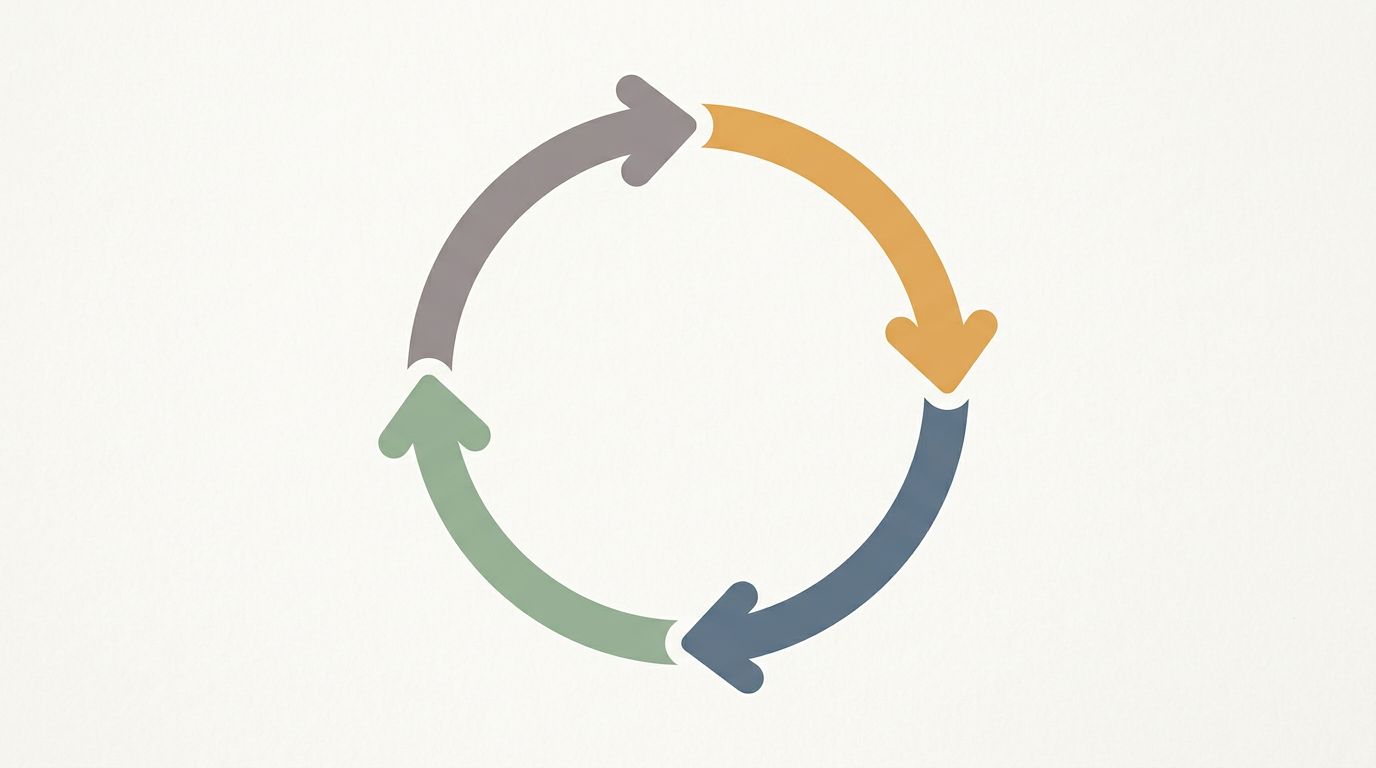
1. Produce — flood the top of the loop. Generate 8–15 genuinely distinct concepts a week, not 15 tweaks of the same ad. Vary the hook, the format (UGC, product demo, explainer), and the angle (problem-first, outcome-first, curiosity-first). AI is what makes this volume possible; a tool like RGBA that turns an idea into a finished video in about three minutes is built for exactly this throughput.
2. Ship — test structurally, not randomly. Launch each concept as its own ad so the algorithm can attribute performance cleanly. Give every variation enough budget to exit the learning phase. Change one meaningful variable per test when you can, so you learn why something worked, not just that it did.
3. Read — decide on signals, not vibes. TikTok's algorithm typically surfaces top performers within 500–1,000 impressions per ad, and most decision windows run 7–14 days. Set thresholds in advance — a target cost-per-result or ROAS hurdle — and judge every creative against the number, not against how much you liked making it.
4. Double down — kill fast, scale winners. Cut the variants that miss the threshold without sentiment. Move budget behind the winners, and — critically — refresh winning concepts every 10–14 days before fatigue sets in. Then feed what you learned back into step one. That feedback loop, not any single ad, is the durable advantage.
Creative testing benchmarks cheat sheet
| Question | Rule of thumb (2026) |
|---|---|
| How many concepts per week? | 8–15 distinct ideas; ship 3–5 net-new creatives |
| How much budget to testing? | 20–30% testing, 70–80% scaling proven winners |
| When can I read a winner? | ~500–1,000 impressions per ad for early signal |
| How long before I decide? | 7–14 day decision window |
| How often to refresh winners? | Every 10–14 days (TikTok fatigues faster than Meta) |
| What should a variation cost? | Aim for single-digit dollars with AI, not $150+ |
Treat these as starting points and let your own data override them. The discipline — pre-set thresholds, fixed cadence, ruthless kills — matters more than the exact numbers.
Common ad creative testing mistakes
- Testing tweaks instead of ideas. Ten button-color variants teach you almost nothing. Ten different hooks teach you where demand actually is — start from these 30 video hook ideas.
- Killing creatives too early — or too late. Deciding before 500 impressions is noise; riding a fatigued winner past two weeks bleeds ROAS.
- No pre-committed threshold. If you decide what "good" means after seeing the results, you'll rationalize your favorites and starve your winners.
- Under-producing. If your pipeline can only make three ads a month, your testing program is capped there no matter how clever the strategy. Volume is a prerequisite, and it's the part AI fixes. This is why creative throughput belongs in your broader social media video strategy, not just your ad account.
How to start ad creative testing this week
- Pick one product and write down five different angles (not five headlines).
- Turn each angle into two or three video variations with an AI video tool — aim for 8–12 assets total.
- Launch them as separate ads with equal budget and a single pre-set success metric.
- At day 7–10, kill everything below threshold and 2–3x the budget on winners.
- Write down the one thing the winners had in common, and make that the seed for next week's batch.
Do this for a month and you'll have run more creative experiments than most brands run in a quarter — for a fraction of the cost. And when a high-stakes window like Black Friday arrives, that same loop is what lets you scale winning creative before Q4 ad CPMs spike.
Frequently asked questions
What is ad creative testing?
Ad creative testing is the structured practice of running multiple ad variations — different hooks, formats, and angles — against the same audience, measuring performance, then killing underperformers and scaling winners. It treats each creative as a hypothesis rather than betting a whole campaign on one ad, and it's now the biggest controllable lever in paid social performance.
How many ad creatives should I test at once?
Most successful advertisers test 8–15 distinct concepts per account per week and ship 3–5 net-new creatives, allocating roughly 20–30% of budget to testing and 70–80% to scaling proven winners. Prioritize genuinely different hooks and angles over minor tweaks, because variety drives learning far faster than small variations do.
How long should I run an ad creative test before deciding?
Plan for a 7–14 day decision window. Platform algorithms typically surface early signal within 500–1,000 impressions per ad, but you want enough spend to exit the learning phase and reach statistical confidence. Decide against a pre-set threshold — a target cost-per-result or ROAS — rather than pausing ads based on a single day's numbers.
Can AI-generated ad creatives perform as well as human-made ones?
Often, yes — especially for volume testing. AI-generated UGC-style content has hit engagement rates around 18.5% versus 5.3% for typical human content in one 2026 study, at roughly $2 per video versus $150+. A common approach is a hybrid: use AI for the high-volume testing loop and reserve human creators for a few high-trust placements.
Why is creative the most important part of paid ads now?
Because the platforms automate the rest. Meta and TikTok now handle targeting, bidding, and delivery with their own AI, leaving creative as the main variable marketers control. Studies attribute 56–80% of ad performance to creative strength, so the size and quality of your creative testing program effectively sets a ceiling on your results.
Sources
- AppsFlyer / creative as 70–80% of Meta performance — The MTM Agency
- Why Creative Diversity Is the #1 Performance Lever in 2026 — Superads
- High-Quality Creative Increases Ad ROI — Meta for Business (Facebook IQ)
- Creative Testing Strategy for Meta & TikTok Ads — Extuitive
- How to Test Ad Creatives on TikTok — RocketShipHQ
- Ad Testing Guide — TikTok for Business
- AI UGC vs Real UGC: Performance Study 2026 — SuperScale
- AI UGC vs Real UGC for Ads: 2026 Comparison — Pose.ai